What a Venue Label Can—and Cannot—Tell You in Quảng Ngãi
Understand what venue labels in Quảng Ngãi can tell you, and verify gambling, access, and service details before making plans or repeating a claim.
The common mistake is to treat a venue label as confirmation of a particular service. In Quảng Ngãi, seeing “resort” or “entertainment venue” does not establish that gambling is available, that visitors can enter, or that a specific activity is operating. The cost is practical: you may make plans or repeat a claim before checking the detail that matters.
For gambling-related claims, the distinction is especially important. A business description is not a statement about what games are offered, who may take part, or what rules apply. Check those matters directly, and avoid presenting an unconfirmed detail as fact.
What does a venue label tell you?
A label is a broad description, not a complete account of a property. “Resort” may suggest a leisure-oriented business, while “entertainment venue” may refer to several kinds of activity. Neither term answers a specific question about facilities, admission, events, or gambling.
Keep the description separate from the practical claim. If a listing calls a place a resort, that supports saying the listing uses that label. It does not support saying the property has a casino or that a visitor can enter a particular facility.
When a detail affects your plans, seek a source that addresses that detail directly. A current notice or direct answer from the responsible venue or organizer is more relevant than an old image or a general directory description.
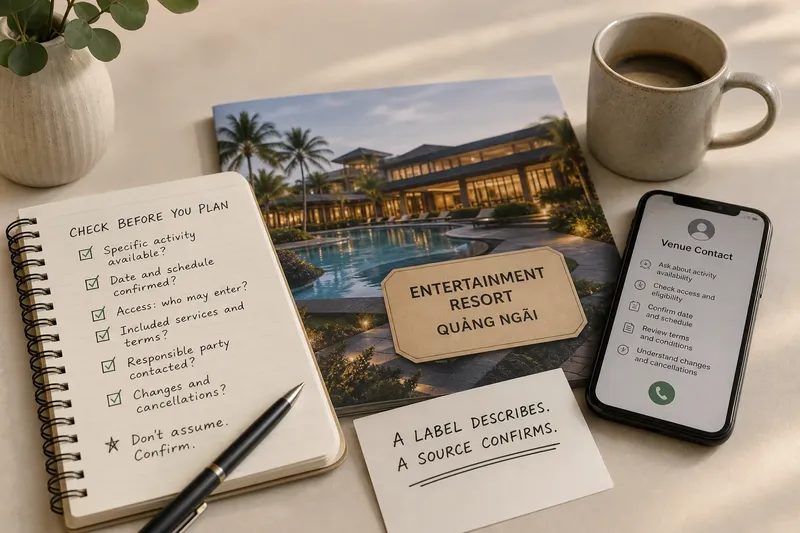
What should you check before making plans?
Start with the question you need answered. Ask whether a named activity is available on your intended date, whether visitors may attend, and whether any terms apply. For gambling, do not infer availability or eligibility from a venue’s general identity; consult the responsible provider and relevant official information where applicable.
- Specific activity: If a current source names the activity, use that source to guide your plan; if it only gives a broad label, ask the venue or organizer what is actually offered.
- Date and schedule: If the information matches the date you have in mind, check any stated conditions; if it is undated or refers to another date, seek a current notice before relying on it.
- Access: If the source clearly explains who may enter, follow those stated conditions; if access is unclear, ask directly and do not assume that the public is admitted.
- Included services: If the offer names a service as included, read its terms; if it merely appears in a photograph or general description, confirm whether it is part of the offer.
- Responsible party: If the venue itself provides the service, direct your question there; if a tenant or event organizer is responsible, contact that party instead.
- Changes and cancellations: If the booking or admission terms explain what happens when plans change, use those terms; if they do not, ask before committing.
For questions involving local rules, eligibility, or legal obligations, rely on relevant official information or consult a qualified professional where needed.
How should you describe an unconfirmed claim?
Say what the source actually establishes. “The listing describes the property as a resort” reports its wording. “The property offers gambling” is a separate claim and needs its own reliable support.
Keep the source and its scope clear when you discuss a venue publicly. A listing may describe a larger property, while an event notice concerns one program. If the information does not answer a question about current access or services, say that the detail remains unconfirmed.
This is not a reason to dismiss every business description. It is a way to avoid turning a broad term into a promise about facilities, admission, or outcomes.
Which questions do readers ask about venue labels?
Does “resort” mean a casino is on site?
No. The word alone does not establish that gambling is offered. Look for a specific, current source about the facility and its access conditions.
Does “entertainment venue” confirm an event is happening?
No. It describes a general kind of place, not a particular program or schedule. Check the current event notice or contact the organizer.
Can a promotional page confirm every service is available?
Not by itself. A page may describe a property broadly or show services with separate conditions. Read the terms for the specific offer and confirm details that affect your plans.
What should I say if I cannot verify a claim?
Report the source’s wording and identify what remains uncertain. Do not turn an inference about facilities or access into a factual statement.
How does this work for a planned visit?
Imagine you are planning an outing in Quảng Ngãi and see a listing call a property an “entertainment resort.” You want to know whether a named activity is available to visitors on your chosen day. You check the listing and find that it gives no schedule or access details. You then contact the party responsible for the activity; if its reply still does not clarify entry, you choose another confirmed option rather than treating the label as an answer. The resulting plan rests on specific information, while the unresolved detail stays visible.
Use the same approach when sharing the information: name the source, state what it confirms, and leave out claims it does not support. That small distinction helps keep a venue description from becoming an unintended promise.
When a label sounds reassuring, ask what has actually been confirmed about the service, date, and access you care about. For gambling-related questions, check the relevant provider and applicable official information rather than relying on a property category. A precise question is more useful than a confident assumption.